


In what is probably the longest-lasting periodization intervention of all time, Eric Hobsbawm first made the 19th century “long”—extending it from the French Revolution in 1789 to the outbreak of World War I in 1914—and then divided it into the Age of Revolutions (1789–1848), the Age of Capital (1848–1875), and the Age of Empire (1875–1914).
Of course, all periodizations depend on particular criteria and can be mechanistic or oversimplified. Yet the question remains: When the time comes to write the history of the 21st century, the 2020s will be the age of what?
Inspired by Christopher Clark’s excellent Time and Power: Visions of History in German Politics, from the Thirty Years’ War to the Third Reich, one might conclude that the outcome of the 21st century will ultimately determine how these decades are interpreted. “As gravity bends light, so power bends time,” Clark argues. Political actors actively reshape the relations between past, present, and future, and that temporal work helps them govern. Assumptions about the past, as well as about the present and the future, become instruments of power.
For example, Clark shows how, in the 17th century, forward-looking reformism used emergency temporalities to override the estates’ ancient privileges. A Clarkian historian might therefore suggest that the real question is not what the 2020s are an age of, but rather who will be using this decade, and to what end.
My own thinking about time has been inspired by François Hartog’s Regimes of Historicity: Presentism and Experiences of Time. Hartog introduces three distinct temporal regimes: one oriented toward the past and emulating its models; another, reformist and future-oriented; and a third, which he believes we inhabit today, in which the present serves as the main reference point for historical comparison.
In his newer book Chronos, Hartog delves into the ancient Greek concept of kairos, which is about the right moment to act. Unlike chronos, which is classical, linear, and measurable time, kairos is about timing, not time. Kairos appears at the break between epochs.
We might be at precisely such a moment. Yet this is also where the danger lies. To claim that epochs are breaking is, to some degree, rhetorical posturing. Those who approach with a “the time is nigh/the clock is ticking” attitude usually come with an agenda—one that draws its strength from a sense of alleged urgency. If we don’t do X, disaster Y will follow. This holds true whether we’re talking about climate, politics, or any other sphere.
In a recent Substack post, Paul Krugman argued that the Pax Americana, beggining in 1945, ended with January 20, 2025. It is very common nowdays to claim that we live in a turning point in history. David Motadel wrote about it for Guardian. But are we? Or, can we really tell?
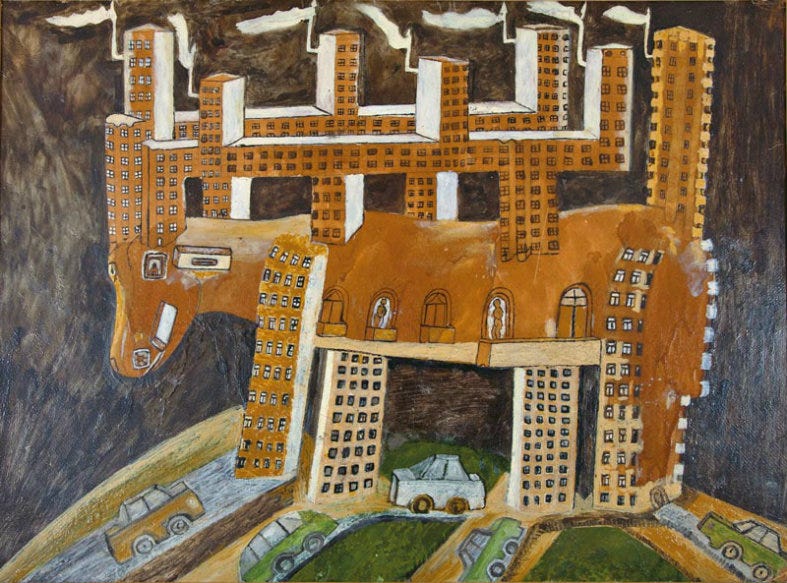
Serbian naïve painter Sava Sekulić made “Deer City” in 1948. (©Slobodan Štetić - Muzej naivne i marginalne umetnosti u Jagodini)
Of course, there is the question of scale and scope. For Ukraine, Russia, Palestine, etc., the coming months or years may determine how the 2020s will be remembered. But what about the world as a whole, or at least Europe?
One way to frame it is through a Toozean polycrisis lens: several smaller crises whose combined effect is greater than the sum of their parts (pandemic, supply-chain disruptions, energy, war, inflation, climate). David Runciman’s podcast ran a series on the “History of Bad Ideas,” and “polycrisis” was among them. One of the talk’s key arguments, namely that the polycrisis concept is pessimistic, only strengthened my belief in how politicized epoch-naming is nowadays.
An outlook in the style of Branko Milanović might name the decade the Age of Bloc-ified Globalization, noting that the center of economic gravity is shifting to Asia amid growing geopolitical ruptures.
My colleague John Raimo suggested this might be the Age of Trauma. I find that very close to my own view. A mix of envy, humiliation, and a strong desire for vengeance seems to fuel many of today’s dynamics—from Chinese policies shaped by the “Century of Humiliation” to anti-establishment sentiment in European countries—especially since, in Europe, there are no visible ideological escape routes. The Age of Trauma might even be an unintended consequence of making trauma such an important part of political grammar in recent decades.
Trauma is, of course, not neutral: what counts as credible suffering, and who counts as a “true” victim, depends on where one stands. Yet so much talk of trauma further emotionalizes politics. I’m not sure this is the Age of Trauma, but it seems closer to the truth than calling it the Age of Populism.
It’s common to talk about the 1930s, but aren’t we closer to the 1920s? The inherited situation is shaky, but it’s still unclear how it will evolve.
I’m reading Vladislav Zubok’s masterful The World of the Cold War: 1945–1991. Zubok creatively divides the Cold War into periods named after Roman deities. The first period is the Time of Mars, which covers the Manichaean binaries of victory and defeat in the early Cold War. The Time of Vulcan refers to the era when thermonuclear weapons made extinction a real possibility, focusing both sides on negotiations and the shoring up of blocs. Détente was the Time of Janus. The end of the Cold War is the Time of Minerva, marked by prudence and negotiated restraint.
Following Zubok, we might be in the Time of Fortuna, an era without clear teleology, where outcomes remain contingent, shocks and cascading risks abound, and grand historical results dependent on ratling dices.
Just a brief comment but I wonder whether Zubok's periodization of sorts isn't a direct allusion (and perhaps a competitive one as well) to Yuri Slezkine's division of Apollonians and Mercurian peoples changing over time in his "The Jewish Century" (2004), not least with the advent of Soviet communism, &c.